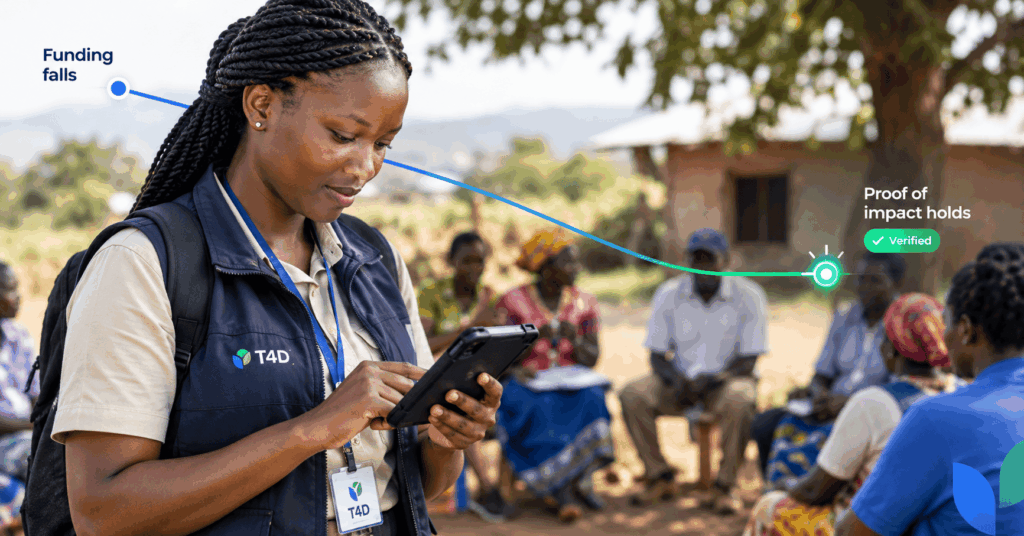
Official development assistance fell 23.1% in 2025, the largest one-year drop in its history, and the OECD expects it to fall another 5.8% in 2026. For NGOs, the question is no longer whether to adapt but how to prove impact on a smaller budget.
The money is shrinking everywhere, not just in Washington
The United States cut its official development assistance from about $63bn in 2024 to just under $29bn in 2025, and the OECD says the US alone drove three-quarters of the global decline. But it was not alone. It was the first time the five largest donors all reduced aid in the same year, with Germany, the UK, Japan and France falling too.
The OECD’s own analysts note that the cuts reached beyond volatile bilateral aid into core development programming. That matters for NGOs, because core programming is where long-running grants live. The same analysis expects another 5.8% fall in 2026.
Kenya feels it twice
Kenya lost 46% of its US funding, and about 54,000 health-care jobs were lost or put at risk. Sector leaders reported a 25% drop in NGO funding in August 2025, against a baseline of Sh196bn a year from international donors, per the NGOs Board’s 2024 report.
The pressure is continental. A pan-African survey cited in a 2026 sector analysis found 38.3% of African NGOs lost more than half their funding, and 72.9% are not confident they can sustain themselves beyond 2026 without new sources.
Then comes the second hit: compliance. Kenya’s Public Benefits Organizations Act set a 13 May 2026 deadline for governance, financial reporting and registration. When Alliance Magazine reported on it, only about 8,458 of an estimated 14,700 PBOs had complied. Organisations are being asked to document more with fewer staff.
Localisation: promised, not funded
For a decade, donors have pledged to send more money directly to local organisations. The Grand Bargain target is 25%. The ALNAP 2026 State of the Humanitarian System report found local and national actors received just 4.3% of direct humanitarian funding in 2025. National NGOs held only 11% of seats on Humanitarian Country Teams in 2024.
The same report points to heavy compliance requirements and high donor risk perceptions as persistent barriers, and cites studies estimating that local intermediaries can deliver programming 32% more cost-efficiently than international ones.
Our reading: if donors hesitate because of perceived risk, then clean data, traceable indicators and on-time reporting are not back-office chores. They are how a local organisation lowers that risk in the donor’s eyes.
AI is everywhere. Readiness is not.
In the 2026 State of Nonprofit AI survey of 917 respondents, 98% reported using AI in some capacity, yet the report finds adoption is moving faster than governance and staff training.
The weak point is data. The 2026 State of Nonprofit AI report by NTEN and The Bridgespan Group found that 47% of nonprofit executives said getting their data organised enough to support AI was still in development, and a separate 2026 technology report found 70% of nonprofits manage five or more platforms, as summarised in Omdena’s data readiness guide.
A systematic review of 65 documents adds that adoption is uneven and skewed toward larger organisations, with smaller NGOs held back by limited infrastructure and staff capacity.
The practical lesson: for most NGOs, the first AI project is really a data project.
What proof on a budget looks like
The cost of weak data shows up in reporting. One software vendor’s 2026 estimate, which is a rough order of magnitude rather than a study, puts manual quarterly reporting across six projects at about 190 person-days a year, against 24 with a suitable tool.
The same source calls offline collection the decisive technical need, because 3G coverage is patchy outside regional capitals. Field teams capture data without a network and sync when they reach town.
Demand for these skills is visible in hiring. A grant monitoring and evaluation officer role at World Vision, listed on a Kenyan jobs site on 2 October 2026, asks for Open Data Kit experience and help setting up a digital data collection and beneficiary tracking system.
Five moves for the next 90 days
These five steps need modest budgets and build on each other.
- Audit before you buy. List every platform, spreadsheet and form that holds beneficiary or grant data, and who owns each. Data governance and ICT4D strategy work starts here.
- Move field data to offline mobile collection. Tools such as ODK and KoboToolbox let teams collect in the field without a network and sync later. T4D offers mobile data collection applications and hands-on training and certification.
- Build one donor-ready dashboard. Pull your core indicators into a single view that can feed the quarterly report. See data visualisation, dashboards and reporting and M&E systems development.
- Confirm your PBO Act standing. Keep governance, financial reporting and registration records current and in one place, so the next donor or regulator request takes hours, not weeks.
- Write an AI policy before you scale AI use. One page on which data may enter AI tools, plus staff training. T4D’s data analytics and AI training covers the foundations.
T4D works with local and international NGOs, civil society organisations, foundations and humanitarian groups on data systems and capacity building. If a donor reporting cycle or compliance deadline is putting your team under pressure, talk to us.