
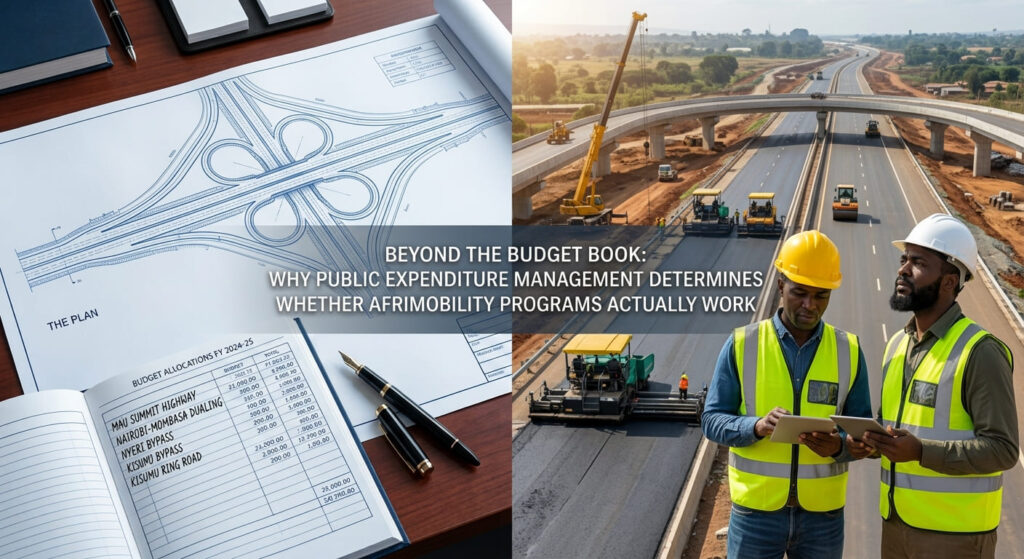
Every year, governments approve budgets with ambitious promises attached for new schools, better roads, expanded healthcare access, and stronger social safety nets. Yet citizens often experience a starkly different reality, revealing why public expenditure management determines whether these programs actually work or quietly fail in execution.
The budget was approved. The money was allocated. So what went wrong?
The answer has little to do with how much money was budgeted and everything to do with how that money was managed once approved. This is the gap between budgeting and public expenditure management (PEM), a divide that determines whether public programs succeed or quietly fail.
The Budget Is a Plan. Expenditure Management Is Execution.
A national or local budget is essentially a statement of intent. It outlines planned spending and expected outcomes. But a budget document, however well-crafted, cannot build a hospital or pay a civil servant. That capability relies on the post-approval machinery: procurement systems, disbursement schedules, cash flow management, internal controls, and monitoring mechanisms.
Public expenditure management is the operational engine that transforms a line item into a completed project. When that machinery is weak, even a well-designed budget produces poor outcomes. According to the World Bank’s Public Expenditure and Financial Accountability (PEFA) framework, low- and middle-income countries frequently suffer from a significant variance between approved budgets and actual outturns, often driven by:
- Unpredictable cash flow release schedules that freeze projects mid-cycle.
- Expenditure off-budget leakage and misallocation prior to service delivery.
- Capital expenditure underspending, where allocated funds revert to central treasuries due to administrative delays.
Where Government Programs Actually Break Down
Finance professionals across the public sector consistently report the same operational failure points:
1. The Disconnect Between Procurement and Budget Timelines
Even when funds are approved in Q1, cumbersome public procurement processes often delay vendor selection until late Q3 or Q4. This forces frantic end-of-year spending or results in unspent funds being returned to the national treasury.
2. Slow or Erratic Fund Release Schedules
Finance ministries frequently disburse funds based on short-term liquidity rather than implementation plans. A health ministry might receive 80% of its equipment budget in the final month of the fiscal year, making meaningful deployment impossible.
3. Opaque Expenditure Tracking
Without integrated financial management information systems (IFMIS) linked directly to project monitoring, leadership lacks real-time visibility into whether spending matches physical progress on the ground.
4. Poor Fiscal Space and Revenue-Timing Analysis
Governments often commit to front-loaded project commitments without accounting for seasonal revenue drops or debt service obligations, causing cash crunches that force work halts.
5. Weak Internal Controls and Compliance Leakage
Without rigorous pre-audit checks and risk management, funds risk being diverted through duplicate payments, inflated invoices, or outright misallocation.
The Cost of Execution Gaps
The global impact of these bottlenecks is substantial:
| PEM Area | Common System Failure | Real-World Impact |
| Cash Management | Lumpy, unpredictable fund transfers | Contractors halt infrastructure work; material costs inflate over time. |
| Procurement | Misaligned operational and tender cycles | Essential supplies arrive months late or expire before distribution. |
| Commitment Control | Unbudgeted multi-year obligations | Accumulation of pending bills, leading to supplier insolvency and high fiscal risk. |
| Project Tracking | Monitoring output expenditure only | High financial absorption rates reported alongside non-functional facilities. |
Why Expenditure Management Matters More Than Ever
Public finances are under sustained pressure. According to global fiscal reporting from the International Monetary Fund (IMF), public debt-to-GDP ratios remain elevated globally, restricting new fiscal space. Competing development priorities and growing citizen demand for transparency leave no room for operational inefficiency.
In this climate, expenditure management can no longer be treated as a back-office administrative function. It is a core strategic driver of public value. Strong execution builds institutional credibility: when citizens see that allocated funds yield completed roads and equipped hospitals on time, trust in public institutions is restored.
Closing the Gap Requires Skilled People, Not Just Policy
Improving public expenditure management is rarely just a policy issue; many countries already maintain adequate legal and structural frameworks. Rather, it is a capacity and implementation challenge.
Budget officers, accountants, procurement specialists, and program managers need practical, hands-on skills in:
- Cash Flow Forecasting: Aligning project milestones with real-time liquidity projections.
- Fiscal Space Analysis: Balancing long-term commitments against revenue cycles.
- Integrated Expenditure Tracking: Verifying physical progress against monetary disbursements.
- Risk-Based Internal Controls: Mitigating leakage while preventing operational bottlenecks.
Closing this gap requires targeted capacity building. The Public Expenditure Budgeting and Management Training Course equips finance and public sector professionals with the technical skills needed to bridge the gap between initial budget allocation and on-the-ground execution.
